April 16, 2026 • Capital Markets Real estate market
July 19, 2026 • Office Real estate market
By INOWAI · Marie ANSAY Senior Consultant Office · July 2026
Before choosing a workplace model, let’s look at the facts.
Some professions simply do not have a choice.
Law firms, audit firms, banks and insurance companies require private offices and assigned workstations due to confidentiality requirements, regulatory obligations and the nature of their work. The private office model is not a preference – it is a structural necessity.
However, even within these organisations, support departments may benefit from a different approach. Marketing, HR, communications and administrative teams do not face the same constraints. This is where optimisation becomes possible. An 80-person law firm, for example, may keep partners in private offices while adopting flexible workstations for support teams, complemented by redesigned shared spaces. This often unlocks 15% to 20% of additional usable space.
For other sectors – technology, professional services and consulting – the question remains entirely open. The answer deserves a thorough analysis rather than a decision made at the time of signing a lease.
This is what we observe in the Luxembourg market.
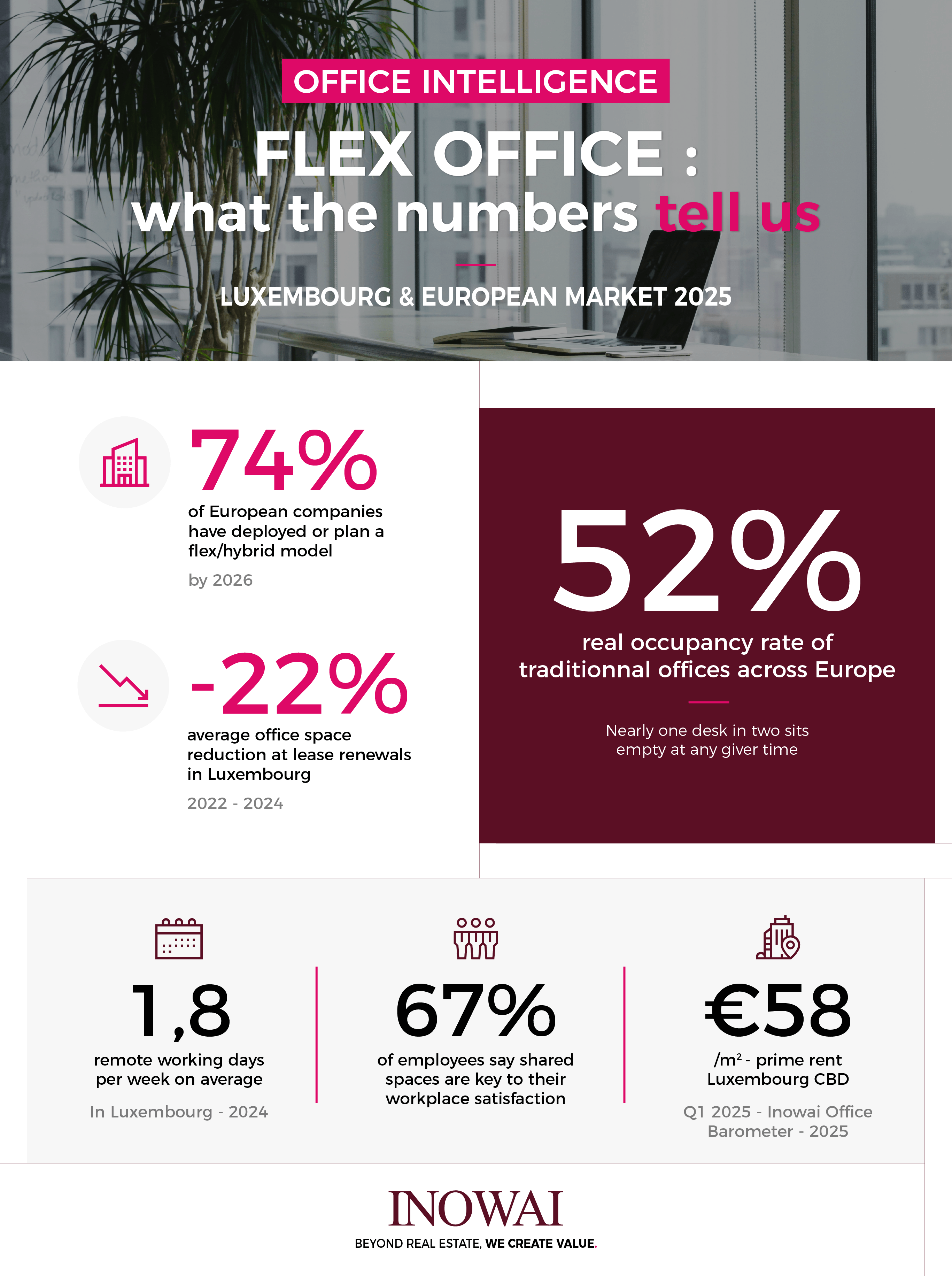
With an actual office attendance rate of around 60% (three days per week), a company employing 100 people generally only needs 65 to 70 desks within a well-designed flexible workplace. In a typical 1,500 m²office, this frees up approximately 300 to 400 m².
At an average rent of €40/m²/month, this represents €144,000 to €192,000 in annual rental savings – or the opportunity to reinvest the same amount into spaces that genuinely create value.
Beyond rental savings, optimizing office space also reduces operating costs. With average service charges ranging from €4 to €8/m²/month, freeing up 300 to 400 m² represents an additional annual saving of approximately €14,400 to €38,400.
And this is often the smartest option: rather than reducing space, transform it.
These freed-up square meters can become:
The objective is not simply to have fewer offices. It is to create workplaces that are useful, vibrant and attractive – better-designed environments that retain talent, improve productivity and give employees a genuine reason to come into the office.
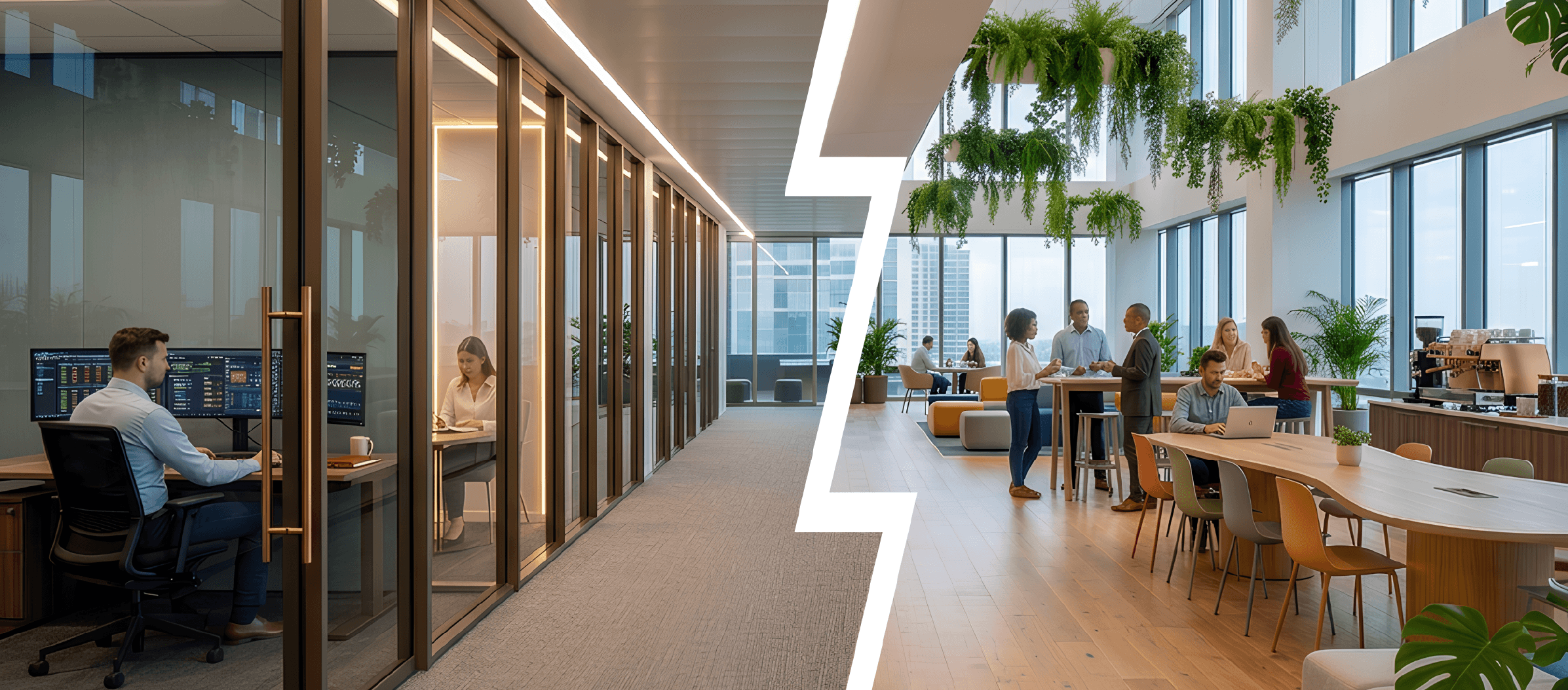
Assigned private offices
Each employee has a dedicated workstation. This model remains relevant for regulated professions, confidential functions and roles requiring continuous on-site presence.
Its main limitation in a hybrid environment is that it often results in empty workstations that continue to generate costs without creating value.
Flex office
No desks are assigned. Employees choose their workspace according to their needs each day.
This model is highly effective when occupancy levels justify it and when the workplace has been carefully designed.
However, if poorly implemented, it can lead to frustration and disengagement – the exact opposite of its intended purpose: loss of reference points, reduced concentration, a weaker sense of belonging and unequal access to the most desirable workspaces.
Hybrid workplace
A combination of flexible work areas assigned desks for selected profiles and dedicated focus spaces.
This is the model we most frequently recommend during our workplace advisory assignments, as it generally provides the best balance for organisations where different types of roles coexist.
Choosing the right workplace model cannot be improvised.
It starts by measuring actual workplace usage – not assumptions, but real data. Then comes forecasting future needs, identifying the right premises and negotiating the right lease.
INOWAI supports its clients throughout each of these stages, before any real estate decision is made.
To go one step further, we work alongside byld, our Design & Build partner, which provides workplace design simulations and costed scenarios for every configuration.
Whether the objective is a fully flexible office, a hybrid workplace or a partial transformation, byld helps clients visualise their future workspace and ensures that every square meter delivers maximum value.
Would you like to assess your workplace optimisation potential or identify the ideal office space for your organisation? Contact our OFFICE team.